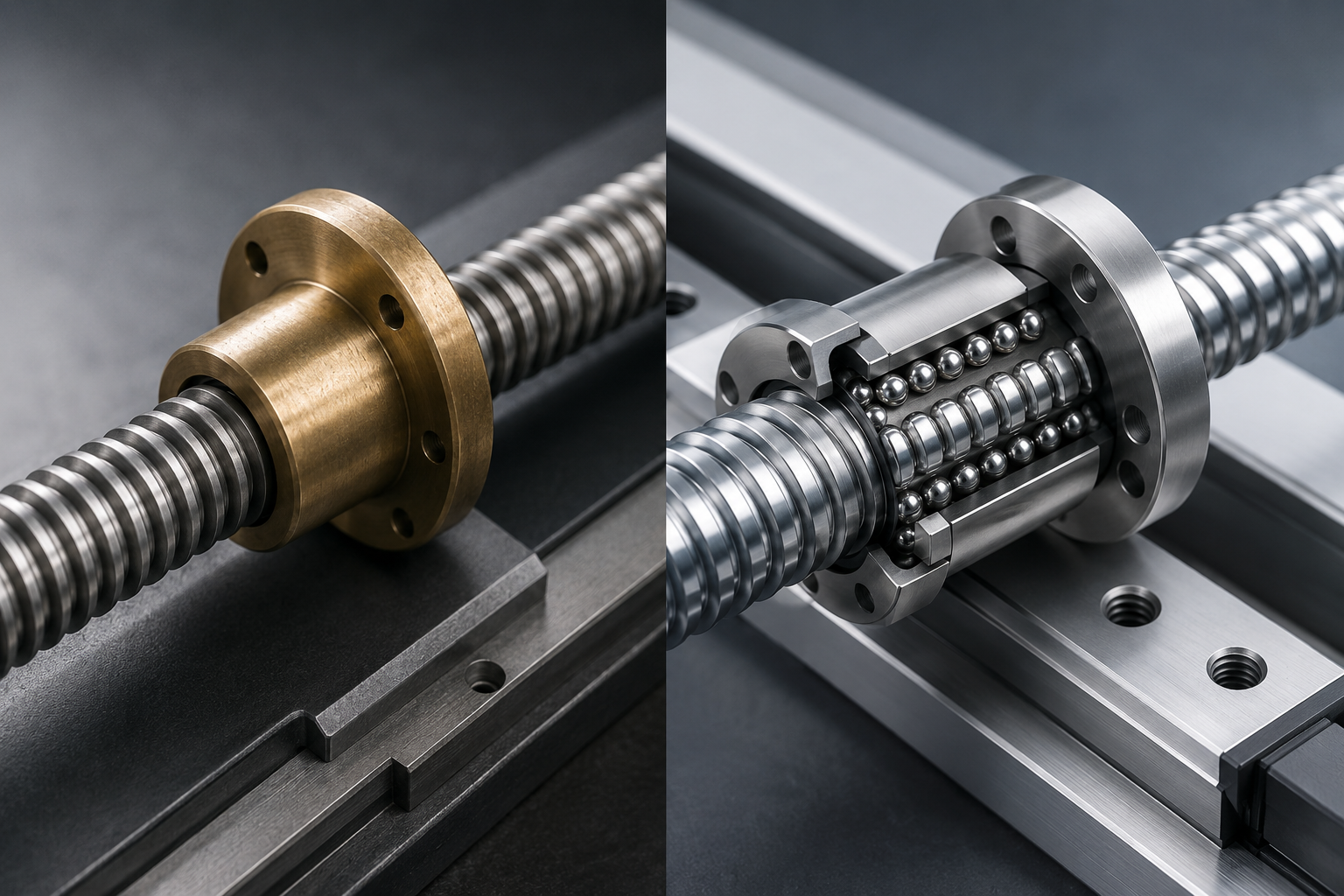
The ball screw and lead screw are widely used in various applications that require linear motion, including machine tools, robotics, computer-controlled manufacturing, industrial machinery, etc. Both are devices that convert rotary motion to linear motion but there are significant differences between the two in terms of design, performance and best application. An understanding of these differences can help businesses choose the right equipment for the solution.
What Is a Lead Screw?
Threaded shaft that is operated by a matching nut to produce linear motion. When the screw is turned the nut slides up its length. The lead screws are relatively simple, inexpensive and easy to maintain.
An important benefit of their use is that they offer high levels of friction and in many applications can be self-locking. This may help to prevent movement of the load when the motor is not running. Lead screws are widely used for positioning equipment, actuators, lifting mechanisms, and other applications that demand high precision and high speed are not a primary requirement.
When selecting these components, it is crucial to select a reputable Lead Screw Supplier for quality material, size uniformity, and reliability.
Ball Screw – What is it?
A ball screw consists of recirculating balls between the ball and the nut. These balls provide much less friction than the sliding contact of traditional lead screws. This makes it possible to achieve better efficiency, positioning accuracy, and smoothness with ball screws.
Ball screws are ideal for use in precision positioning systems, robotics, automation systems and CNC machines. They can also run faster and perform more demanding motion control requirements.
When it comes to specialized applications, the manufacturer can benefit from the help of a precision lead screw manufacturer Canada to get the components they need to fit with specific loads, travels and positioning requirements.
Lead Screws vs. Ball Screws: The Key Differences
The difference between the two is the nature of the interaction between nut and screw. A lead screw will rely on sliding friction, while a ball screw will rely on rolling balls. This results in better efficiency and is typically more suitable for high speed, high precision applications.
Lead screws tend to be less expensive and easier to make. In some arrangements they can also exhibit self-lock capability. However, ball screws tend to offer greater efficiency, accuracy and service performance at higher cost, and with the need to be adequately lubricated and maintained.
Selecting the appropriate screw for the job at hand
The decision relies on various factors including load capacity, speed, accuracy, operating environment, maintenance needs, and budget. In cases of economical motion-control solutions, it might be better to use a lead screw. If high precision is required, a ball screw might be better suited.
It is easier to choose the right screw specification and configuration with the help of an experienced lead screw manufacturer Toronto. A knowledgeable reliable lead screw supplier can also help with material, dimension, coating and customization considerations for particular industrial applications.
Read Also: How to Choose the Right Cold Forging Supplier for Your Manufacturing Needs