In the comparison of closed die forging with open die forging, it is apparent that both processes are of great importance in contemporary manufacturing—their difference being primarily in technique, precision, and applications. That is why an excellent understanding of these differences helps not only engineers and buyers but also a die casting supplier to exercise the choice of a correct method for the specific project requirements. In this informative post, we will discuss about closed die forging vs open die forging.
What Is Closed Die Forging?
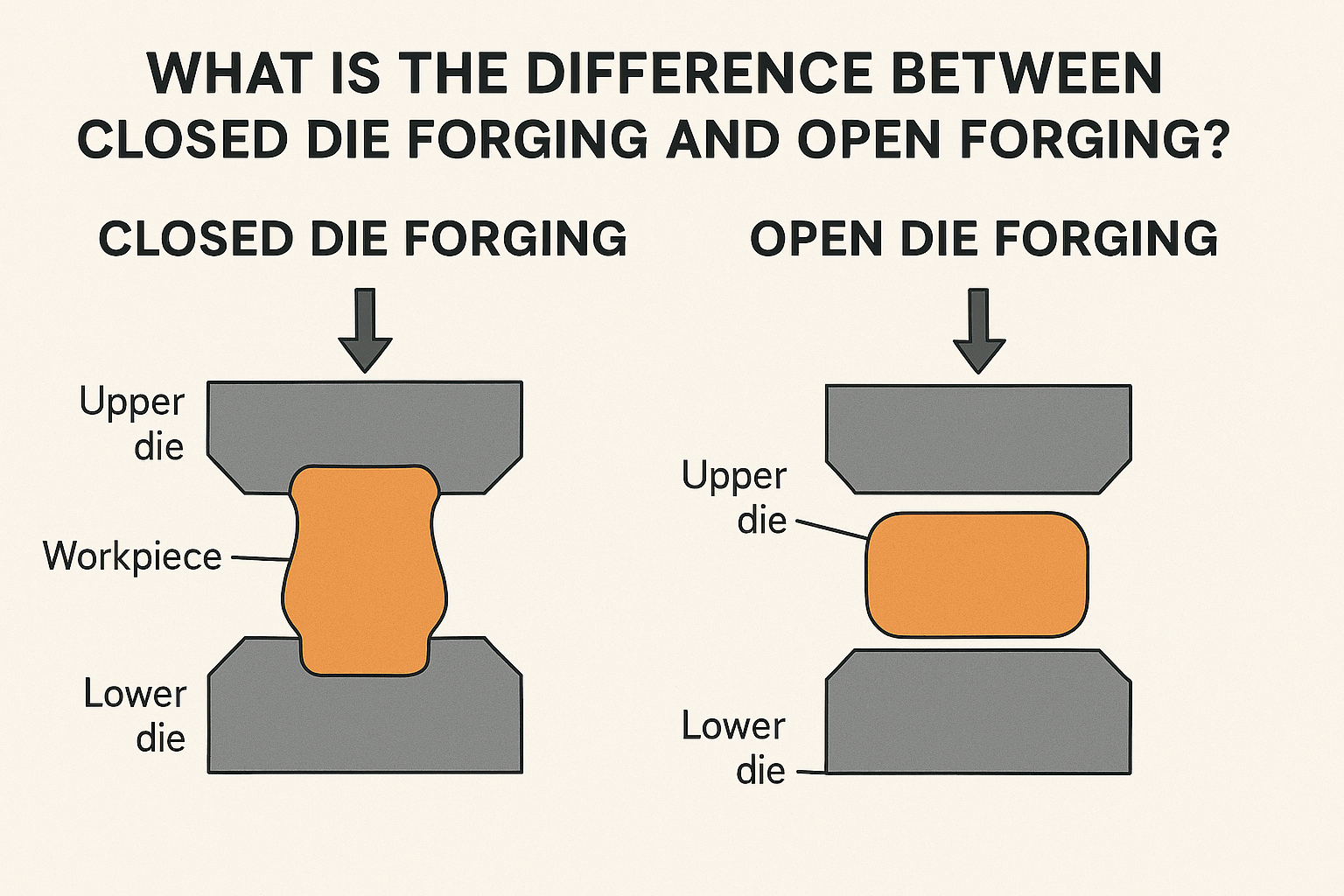
Closed die forging or precision forging is a process where two or more dies with a pre-cut cavity shaped like the final product are utilized. The metal that has been heated and placed between the dies is then compressed and takes the shape of the cavity, thus producing a near-net shape.
This method is very much suitable for the manufacture of large quantities of the same parts with really high dimensional accuracy. The reason is simple; the metal is directed into a defined cavity, and thus the manufacturers can obtain very tight tolerances and also make complex shapes.
Advantages of Closed Die Forging:
- High precision and repeatability
- Excellent surface finish
- Mass production compatible
- Minimal machining required
What Is Open Die Forging?
Open die forging, also known as free forging, makes use of the large tool or flat dies compressing the metal and the material being repositioned in between the blows instead of a closed cavity. The metal is reshaped in several stages thus the process is flexible.
This technique is usually the one to go for when it comes to the production of large and simple shapes such as rings, bars, shafts, and blocks. The open die forging technique makes parts that are incredibly strong and have great structural integrity due to the metal that is repeatedly worked.
Advantages of Open Die Forging:
- Very large components are suitable
- Properties of the material are very good
- Custom or low-volume production is flexible
- Internal defects are reduced
In case your goal is to produce a large number of components with precise dimensions and complex geometries, then the closed die forging is the right choice. In the case of large parts requiring very sound and durable compounding, or if you are operating with very small amounts, open die forging is the method suggested. In circumstances where you contemplate the various forging techniques or you are already in the process of purchasing from a die casting supplier, knowing these methods would provide you with better options, increased efficiency and lower production costs.
Read Also: What are the different types of warehouse functions?